" width="161.0553300990179px"><path d="M 0.01 8.038 L 0.01 0 L 5.785 0 L 5.785 1.298 L 1.439 1.298 L 1.439 3.249 L 4.859 3.249 L 4.859 4.537 L 1.439 4.537 L 1.439 6.74 L 5.895 6.74 L 5.895 8.038 L 0 8.038 Z" fill="rgb(48, 56, 92)" height="8.038229348817936px" id="NdETR_kOZ" transform="translate(155.16 43.049)" width="5.895372213275721px"/><path d="M 6.408 8.038 L 4.809 8.038 L 3.209 5.131 L 1.439 5.131 L 1.439 8.038 L 0 8.038 L 0 0 L 3.421 0 C 5.01 0 6.107 1.117 6.107 2.575 C 6.107 3.632 5.533 4.497 4.628 4.899 L 6.398 8.048 Z M 1.449 1.298 L 1.449 3.833 L 3.41 3.833 C 4.155 3.833 4.688 3.3 4.688 2.565 C 4.688 1.831 4.155 1.288 3.41 1.288 L 1.449 1.288 Z" fill="rgb(48, 56, 92)" height="8.048289713180516px" id="VDwIhYaYQ" transform="translate(147.333 43.049)" width="6.408450680382714px"/><path d="M 0 8.038 L 3.179 0 L 4.769 0 L 7.938 8.038 L 6.408 8.038 L 5.664 6.066 L 2.243 6.066 L 1.489 8.038 L 0.01 8.038 Z M 2.726 4.799 L 5.181 4.799 L 3.964 1.569 L 3.944 1.569 Z" fill="rgb(48, 56, 92)" height="8.03822935104182px" id="hjtMOI6D3" transform="translate(138.369 43.049)" width="7.937625732063623px"/><path d="M 0 4.155 C 0 1.851 1.851 0 4.296 0 C 5.936 0 7.062 0.855 7.636 1.539 L 6.65 2.384 C 6.187 1.891 5.503 1.308 4.296 1.308 C 2.696 1.308 1.449 2.575 1.449 4.155 C 1.449 5.734 2.696 7.002 4.296 7.002 C 5.503 7.002 6.227 6.419 6.7 5.885 L 7.696 6.73 C 7.103 7.445 5.936 8.3 4.296 8.3 C 1.851 8.3 0 6.449 0 4.145 Z" fill="rgb(48, 56, 92)" height="8.29979876442404px" id="AE2ZVg365" transform="translate(130.562 42.918)" width="7.696177036102256px"/><path d="M 0 12.646 C 0 5.241 5.241 0 11.227 0 C 15.312 0 18.28 2.213 19.336 3.924 L 19.386 3.924 L 19.386 0.503 L 25.131 0.503 L 25.131 24.779 L 19.386 24.779 L 19.386 21.358 L 19.336 21.358 C 18.28 23.068 15.302 25.282 11.227 25.282 C 5.231 25.282 0 20.04 0 12.636 Z M 19.396 12.646 C 19.396 8.461 16.328 5.342 12.596 5.342 C 8.863 5.342 5.744 8.461 5.744 12.646 C 5.744 16.831 8.813 19.95 12.596 19.95 C 16.378 19.95 19.396 16.831 19.396 12.646 Z" fill="rgb(48, 56, 92)" height="25.28169005347032px" id="MH_XqxaO9" transform="translate(135.844 11.418)" width="25.130784616519264px"/><path d="M 0.01 24.779 L 0.01 0.503 L 5.704 0.503 L 5.704 3.924 L 5.805 3.924 C 6.861 2.213 9.577 0 13.209 0 C 18.652 0 22.676 3.984 22.676 10.523 L 22.676 24.779 L 16.932 24.779 L 16.932 10.875 C 16.932 7.505 14.819 5.382 11.791 5.382 C 8.32 5.382 5.694 7.998 5.694 11.781 L 5.694 24.779 L 0 24.779 Z" fill="rgb(48, 56, 92)" height="24.778671947607762px" id="RxL7gUHp6" transform="translate(109.094 11.418)" width="22.676056260620328px"/><path d="M 0 3.702 C 0 1.569 1.801 0 3.763 0 C 5.725 0 7.465 1.569 7.465 3.702 C 7.465 5.835 5.664 7.404 3.763 7.404 C 1.861 7.404 0 5.835 0 3.702 Z M 0.885 36.197 L 0.885 11.922 L 6.58 11.922 L 6.58 36.197 Z" fill="rgb(48, 56, 92)" height="36.19721412814856px" id="XvIHduGh_" transform="translate(96.428 0)" width="7.465191125849017px"/><path d="M 0.02 24.779 L 0.02 0.503 L 5.714 0.503 L 5.714 3.924 L 5.815 3.924 C 6.67 2.213 9.135 0 12.716 0 C 16.489 0 19.165 2.314 20.07 4.034 L 20.171 4.034 C 21.177 2.324 24.095 0 28.481 0 C 33.219 0 37.193 3.984 37.193 10.372 L 37.193 24.779 L 31.499 24.779 L 31.499 10.624 C 31.499 7.254 29.386 5.382 26.811 5.382 C 23.793 5.382 21.419 7.746 21.419 11.529 L 21.419 24.779 L 15.724 24.779 L 15.724 10.624 C 15.724 7.254 13.662 5.382 11.087 5.382 C 8.068 5.382 5.694 7.746 5.694 11.529 L 5.694 24.779 L 0 24.779 Z" fill="rgb(48, 56, 92)" height="24.778671947607762px" id="Hvkbp0DiH" transform="translate(54.275 11.418)" width="37.19315882675835px"/><path d="M 0 14.256 L 0 0 L 5.694 0 L 5.694 13.903 C 5.694 17.274 7.807 19.396 10.885 19.396 C 14.356 19.396 16.932 16.831 16.932 12.998 L 16.932 0 L 22.676 0 L 22.676 24.276 L 16.932 24.276 L 16.932 20.855 L 16.881 20.855 C 15.825 22.565 13.109 24.779 9.427 24.779 C 3.984 24.779 0.01 20.795 0.01 14.256 Z" fill="rgb(48, 56, 92)" height="24.778671947607762px" id="CeOmNBjCt" transform="translate(25.786 11.921)" width="22.676056260620328px"/><path d="M 0 35.251 L 0 0 L 6.298 0 L 6.298 29.467 L 23.119 29.467 L 23.119 35.262 L 0 35.262 Z" fill="rgb(48, 56, 92)" height="35.2615491754045px" id="FGWvEP7P8" transform="translate(0 0.945)" width="23.118712194722946px"/></g><g d="M 23.662 23.652 L 18.089 23.652 L 5.302 10.865 L 10.875 5.292 L 19.718 14.135 C 22.243 16.66 23.662 20.08 23.662 23.652 Z M 31.539 31.539 L 31.539 37.112 L 44.326 49.899 L 49.899 44.326 L 41.056 35.482 C 38.531 32.957 35.111 31.539 31.539 31.539 Z M 23.662 31.539 L 18.089 31.539 L 5.302 44.326 L 10.875 49.899 L 23.662 37.112 Z M 31.549 31.539 L 23.662 31.539 L 23.662 55.191 L 31.549 55.191 Z M 23.652 23.652 L 0 23.652 L 0 31.539 L 23.652 31.539 Z M 23.662 0 L 31.549 0 L 31.549 23.652 L 55.201 23.652 L 55.201 31.539 L 43.944 31.539 C 32.746 31.539 23.662 22.465 23.662 11.258 Z" fill="transparent" height="55.19074309888927px" id="b6Izkheg_" transform="translate(174.799 0)" width="55.20120735070978px"><path d="M 18.36 18.36 L 12.787 18.36 L 0 5.573 L 5.573 0 L 14.416 8.843 C 16.942 11.368 18.36 14.789 18.36 18.36 Z" fill="rgb(255, 206, 85)" height="18.360191084206246px" id="QnnZEjJm4" transform="translate(5.302 5.292)" width="18.360160903119862px"/><path d="M 0 0 L 0 5.573 L 12.787 18.36 L 18.36 12.787 L 9.517 3.944 C 6.992 1.419 3.571 0 0 0 Z" fill="rgb(52, 132, 230)" height="18.360160903119834px" id="upLWGlvlt" transform="translate(31.539 31.539)" width="18.360160903119834px"/><path d="M 18.36 0 L 12.787 0 L 0 12.787 L 5.573 18.36 L 18.36 5.573 Z" fill="rgb(246, 99, 96)" height="18.360160903119834px" id="k83_Dx6D1" transform="translate(5.302 31.539)" width="18.360160903119862px"/><path d="M 7.887 0 L 0 0 L 0 23.652 L 7.887 23.652 Z" fill="rgb(69, 87, 187)" height="23.65191138807384px" id="bNp3pemyD" transform="translate(23.662 31.539)" width="7.887323916737529px"/><path d="M 23.652 0 L 0 0 L 0 7.887 L 23.652 7.887 Z" fill="rgb(255, 146, 130)" height="7.887323916737511px" id="OSTMwHPUS" transform="translate(0 23.652)" width="23.651911388073785px"/><path d="M 0 0 L 7.887 0 L 7.887 23.652 L 31.539 23.652 L 31.539 31.539 L 20.282 31.539 C 9.085 31.539 0 22.465 0 11.258 Z" fill="rgb(135, 205, 255)" height="31.539235304811328px" id="puj1hGwnO" transform="translate(23.662 0)" width="31.539235304811342px"/></g></svg>)


Roughly half of every Medicare-covered stay in a skilled nursing facility ends with the resident going home. In fiscal years 2023 and 2024 combined, the median facility risk-adjusted rate of successful discharge to the community was 51.5%, a figure that has held steady for several years. Those residents leave after an average of roughly 30 covered days, and for most of them, the discharge is the end of the operator's clinical involvement.
The 30-day clock, however, does not stop at the door. All-cause hospitalization within 30 days of discharge remains attached to the stay, and the median facility rate of potentially preventable readmissions after SNF discharge sits at 10.7%. What makes this window difficult to manage is that the risk during that period is not evenly distributed.
A retrospective cohort study of Medicare beneficiaries discharged from a heart failure hospitalization to a SNF and then home found that the hazard of readmission or death was significantly higher on days 0 through 2 than across days 3 through 30.
The most dangerous stretch of the post-discharge period begins the moment the resident arrives home, which is precisely when facility visibility ends.
Transitional Care Management (TCM) covers that stretch. It is a Medicare-recognized service with defined clinical requirements, established billing codes, and a growing body of evidence behind it. It is also one of the least used services in the program.
Only 14.5 percent of eligible Medicare discharges involved TCM, and adoption thins considerably once you look at the populations most likely to need it.
Among dual-eligible beneficiaries, TCM codes were billed for fewer than 10 percent of discharges. Along the hospital-to-SNF-to-home path specifically, uptake has been lower still. One analysis of Medicare beneficiaries with dementia hospitalized for heart failure found TCM occurring in 2.3% of eligible hospital-SNF-home discharges in 2013, rising only to 9.8% by 2017.
The residents least equipped to manage the transition home are the ones least likely to receive structured support during it.
How It Works: TCM Explained
TCM is a 30-day service period that begins on the day a patient is discharged from a qualifying inpatient setting, including a skilled nursing facility (SNF), and continues for the following 29 days. Its structure is deliberately weighted toward the period where hospitalization risk is highest.
For the resident returning home, a well-run program delivers:
Discharge and care planning that begins before the transition, not after
Interactive contact from clinical staff within two business days of discharge
Medication reconciliation completed on or before the follow-up visit
A face-to-face or telehealth visit inside the required window
Home health, durable medical equipment, and specialty services arranged proactively
Ongoing clinical oversight across the full 30 days to identify changes in condition early
A recommendation to return to the facility for care when clinically appropriate, rather than defaulting to the emergency department
For clinical leadership and operations teams, a good TCM programs delivers:
Coordinated handoffs between facility staff and community primary care
CMS-aligned workflows that keep documentation and reimbursement requirements aligned
EHR-integrated documentation that supports compliance and follow-up
Continuous visibility into resident progress after discharge, without adding to facility workload
Hospitalization data to support admissions and referral relationships
Reporting on the causes of any hospital transfers
The evidence supports the model rather than any specific single component. A 2025 analysis of dual-eligible Medicare and Medicaid beneficiaries found that billing TCM codes was associated with a 13% relative reduction in 30-day readmission and a 9% relative reduction in emergency department visits, regardless of whether the practice participated in the Medicare Shared Savings Program.
A Health Affairs study of more than 1.6 million eligible discharges found that patients who received TCM reduced Medicare spending by more than $500 in the 31 to 60 days following discharge.
How It's Billed
TCM is billed through two CPT codes, and the requirements attached to each are specific enough that a program either meets them or does not.
CPT 99495. At least moderate-complexity medical decision-making during the service period, with interactive contact by phone, email, or in person within two business days of discharge and a face-to-face visit within 14 calendar days.
CPT 99496. High-complexity medical decision making, with the same two-business-day contact requirement and a face-to-face visit within seven calendar days.
Both codes carry the same set of conditions:
Medication reconciliation must be completed on or before the date of the face-to-face visit
Either code may be furnished via telehealth
Only one physician or qualified non-physician practitioner may report TCM services
The service may be reported once per patient during the 30-day period
The point that matters most for operators is who is in charge of billing. TCM is reported by the practitioner assuming responsibility for the patient's care in the community setting, not by the facility the patient is leaving. The facility does not carry the coding, the documentation burden, or the reimbursement risk.
What the facility carries is the outcome, because the resident's readmission still lands against the stay and against the community discharge measure.
That structure is what makes TCM unusual as an operational decision. The clinical upside accrues to the resident and to the facility's quality performance, while the cost of delivering the service is already covered under Medicare Part B and sits with the billing practice. There is no incurred cost, no added staffing line, and no new workflow for floor staff to absorb.
Transitional Care Management Programs at Lumina Care
Lumina Care’s TCM program drives improvements to care delivery across the transition home for SNF residents. Our program is built as a support layer that works alongside facility staff, primary care providers, and community-based providers.
Across a multi-state SNF partner network, residents enrolled in Lumina Care's TCM program showed lower hospitalization rates than residents without TCM in every measured month.
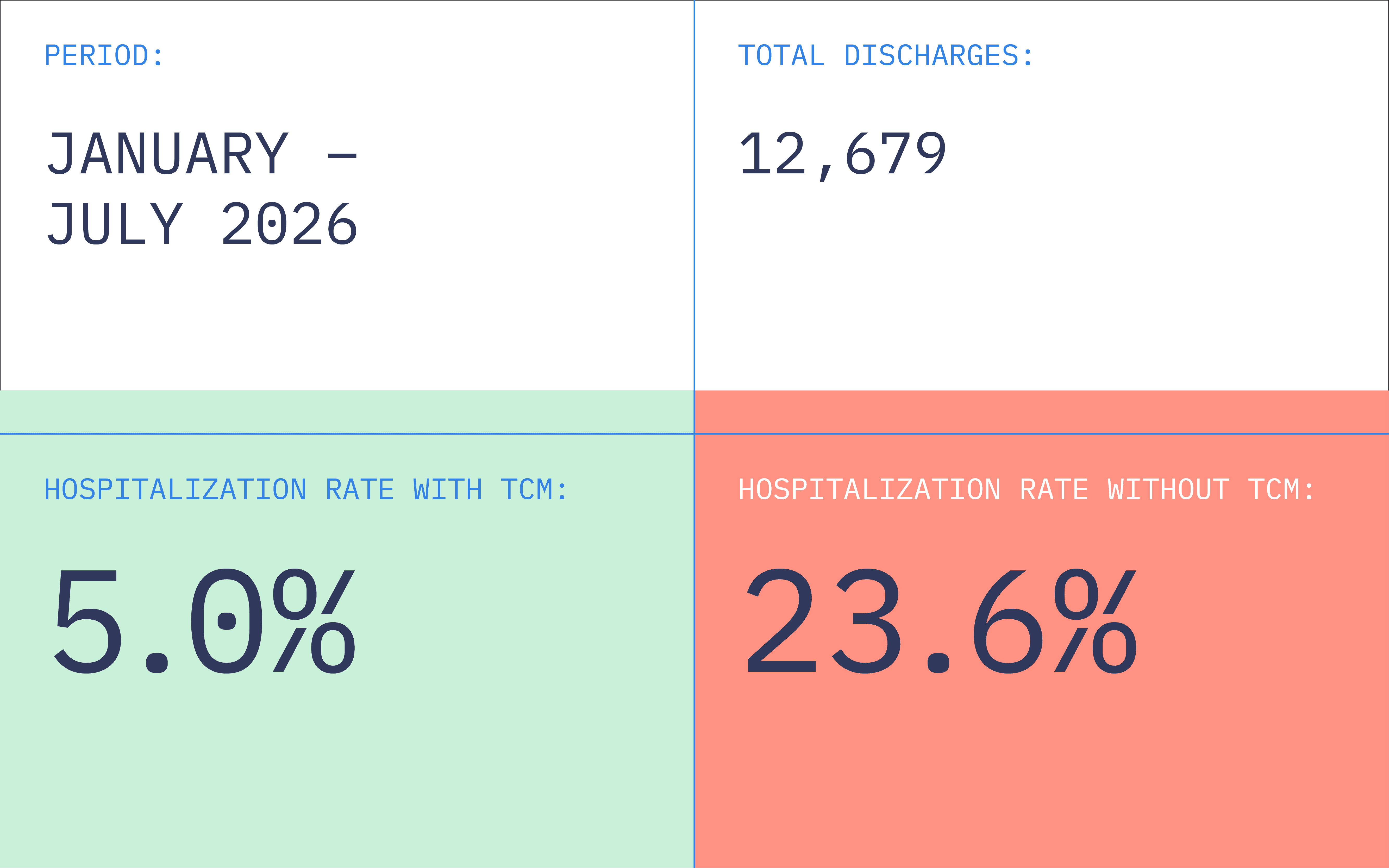
Similar results are available in the multi-state operator case study.
Is TCM Right for My SNFs?
For operators with meaningful short-stay volume, the answer follows from the discharge numbers. About half of Medicare-covered stays end with the resident going home, which means roughly half of the short-stay census is eligible for a service that few eligible Medicare patients actually receive.
Those residents are moving from an environment with 24-hour clinical coverage into a home setting where medications may have changed, labs may still be pending, and the care team they have relied on for weeks is no longer present.
The evidence on TCM is consistent across payer populations and study designs, and the operational case is straightforward:
Measurable improvement on the metrics that determine referral relationships and quality standing
A program delivered at a cost Medicare already covers
No added workload for SNF staff.
See what a fully staffed transition looks like across your facilities. Get in touch.
Lumina Care delivers continuous, coordinated care by connecting providers nationwide. At all hours and across settings, we integrate directly with your team to reduce complications, improve outcomes, and support around-the-clock clinical care without adding to your workload.